What Hunter SkyCommand Is
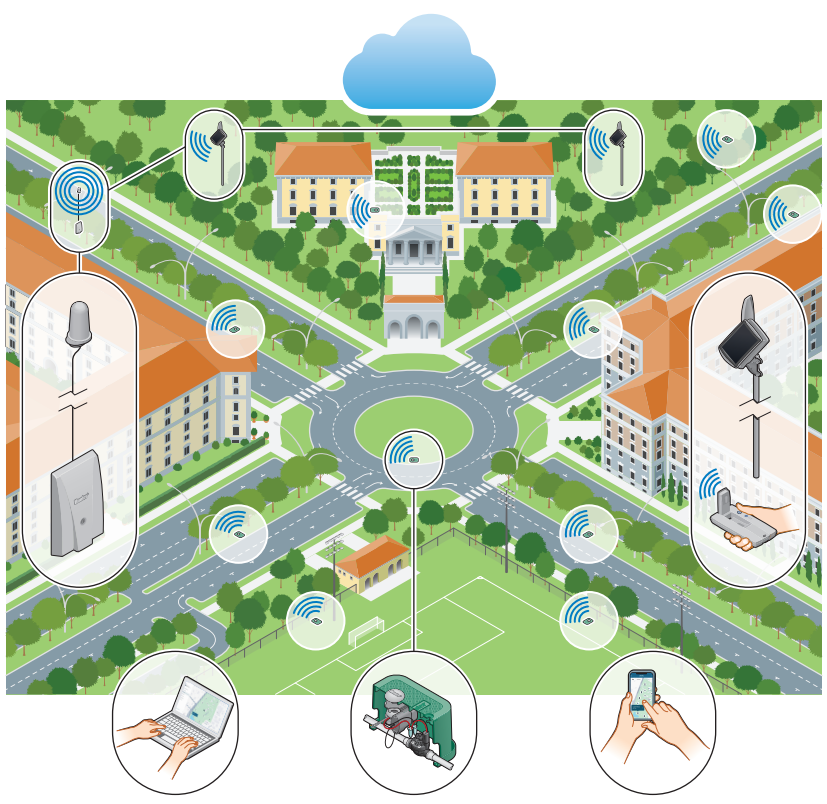
Hunter SkyCommand is a 2026 wireless central-control platform for sites where trench, spare wire, or AC at the valve is the expensive part of the job. Battery-operated BOC controllers mount in valve boxes, talk to a site hub over license-free LoRa radio, and are programmed from Hunter Centralus in Chrome or Safari. Hunter rates each BOC IP68 (submersible). The hub is IP55, wall-mounted, and powered by 120/230 VAC.
A site can run up to 100 devices / 400 stations. Centralus allows unlimited sites, and SkyCommand can sit in the same software as ACC2, ICC2, MCC, and Pro-C. Repeaters extend LoRa to about 3 miles. Field radios are 915 MHz in North America.
How The System Is Wired (It Mostly Isn’t)
- Hub: Mount one Hunter UCH per site. Give it AC power.
- Cloud module: Plug in exactly one of A2C-WIFI (2.4 GHz), A2C-LAN (Ethernet), or A2C-LTEM (LTE, plan required).
- Field radio: Plug A2C-LORA into the other UCH slot. Put the antenna outdoors; Hunter recommends ANT-EXT-KIT.
- Field nodes: Install BOC controllers at the valves. Each station uses a Hunter 458200 DC-latching solenoid up to 100 feet from the BOC.
- Optional: RPT solar repeaters for range, BOC-SOL instead of D-cells, SC-PROBE soil moisture, HC flow meters on BOC-100-FL, and Rain-Clik / Mini-Clik at the hub.
Hunter is explicit: A2C-LORA does not currently fit ACC2. It is a UCH module. The Wi-Fi, LAN, and LTE cards are the same A2C family already used on ACC2, and they also fill the UCH cloud slot.
BOC Field Controllers
Every BOC runs on four D-cell batteries (or BOC-SOL), stores its program on board, and has a gray-loop input for Hunter SC-PROBE soil moisture. Cut the loop and splice the probe with waterproof connectors. That onboard memory is why a radio drop does not stop irrigation — Centralus is for programming and visibility, not second-by-second permission to water.
| Model | Stations | Extra inputs | Typical job |
|---|---|---|---|
| BOC-100 | 1 | Soil moisture | Isolated valve, median, remote shrub bed |
| BOC-100-FL | 1 | Soil moisture + flow (HC meters) | Master valve, high-flow shutdown |
| BOC-200 | 2 | Soil moisture | Two valves in one box |
| BOC-400 | 4 | Soil moisture | Manifold / max stations per node |
BOC-100-FL is the odd one out on purpose. Hunter documents it as a master-valve controller: one station output plus blue/white flow leads (blue to HC blue +, white to white -). Pair it with an HC flow meter for local high-flow shutdown and Centralus leak reporting.
UCH Hub, Bluetooth, And Rain Shutdown
The Universal Communication Hub is 14.2 in high, 9.0 in wide, and 3.1 in deep. The door slides up — leave about 15 extra inches of vertical clearance to remove it. Commissioning uses the Bluetooth button on the hub; Location Services must be on. After pairing, the UCH shows up in Centralus as a new site and you add BOCs to that site.
Rain shutdown lives at the hub, not on every BOC. Hunter lists Rain-Clik and Mini-Clik as compatible hub sensors. Firmware updates use the SDHC slot (a card ships with the UCH). Every UCH also includes a 1.5 in hole saw for mounting BOCs through valve-box lids.
Power, Solar, And Lightning
Default BOC power is four D-cells. BOC-SOL replaces those cells with a LiFePO4 solar kit, a replacement compartment cap, and 40 ft of cable. Remove the alkalines; do not parallel them with the solar pack. Aim the panel at all-day sun. Wall hardware is in the box; pole mounts need 5/16 in stainless band clamps.
LoRa is wireless on purpose: fewer copper paths into the controller, and Hunter calls out lightning isolation as a benefit versus long 24 VAC home runs. That does not make the UCH surge-proof — it still sits on AC with a 250 V 2 A fuse.
Site Survey (SST) And Repeaters
Walk the radio path with the SST Site Survey Tool before you bury hardware. The handheld is IP55, about 8.5 in long. Use it to decide whether you need RPT solar repeaters. Hunter allows multiple in-line repeaters for roughly 3-mile coverage; the same RPT SKU we already carry for WVL is listed on the SkyCommand bill of materials.
SkyCommand vs NODE-BT vs WVL
- NODE-BT is a Bluetooth battery controller you stand next to with a phone. It is not Centralus campus control.
- WVL is LoRa valve links hung off ICC2/HCC (and Hydrawise/Centralus on those controllers). It is a different architecture than a UCH + BOC site.
- SkyCommand is the UCH + BOC + Centralus stack for wire-free wide-area sites, including places that never had a conventional controller.
What To Order
- One UCH per site, plus A2C-LORA, plus one cloud module.
- BOCs by station count. Add BOC-100-FL if you want a wireless master valve and flow.
- 458200 solenoids for every station (and the master valve).
- Optional: ANT-EXT-KIT, RPT, BOC-SOL per BOC, SST for the truck, SC-PROBE, HC flow meter, Rain-Clik.
Big Irrigation carries the SkyCommand BOC controllers, UCH hub, A2C-LORA module, BOC-SOL solar kit, and SST survey tool. If you are specifying a job, send the site map, station counts, and whether the hub will use cell, Wi-Fi, or LAN.
Frequently Asked Questions
Does SkyCommand need constant cell coverage at every valve?
No. Only the UCH needs a cloud path (cell, Wi-Fi, or Ethernet). BOCs use LoRa to the hub and keep watering from onboard memory if that link drops.
Can I mix BOC-100 and BOC-400 on one hub?
Yes. Mix station counts on the same site up to 100 devices or 400 stations.
What browser does Centralus require?
Hunter specifies Chrome or Safari. Transport is MQTT on AWS with TLS.
Is this a replacement for Hydrawise?
No. SkyCommand is a Centralus commercial/wide-area platform. Hydrawise remains the residential/light-commercial app stack on HCC, Pro-HC, HPC, and related controllers.