Landscape Lighting Wiring Basics
Low-voltage landscape lighting runs on 12 volts AC, making it safe to install without an electrician in most jurisdictions. The system has three main components: a transformer (converts 120V household power to 12V), landscape wire (carries power to fixtures), and the fixtures themselves.
Proper wiring is the difference between a lighting system that performs flawlessly for decades and one that dims, flickers, or fails within months. This guide covers everything from wire gauge selection to burial depth to connector types.
Step 1: Choose the Right Wire Gauge
Wire gauge determines how much voltage reaches your fixtures. Thicker wire (lower gauge number) carries power with less voltage drop over distance. Here’s the selection guide:
| Wire Gauge | Max Wattage at 50 ft | Max Wattage at 100 ft | Best For |
|---|---|---|---|
| 16 AWG | 100W | 50W | Short runs, 2-4 LED fixtures |
| 14 AWG | 150W | 100W | Medium runs, 4-8 fixtures |
| 12 AWG | 200W | 150W | Long runs, 8-15 fixtures |
| 10 AWG | 300W | 200W | Very long runs, 15+ fixtures or high-wattage |
When in doubt, go one gauge thicker. The extra cost of heavier wire is minimal compared to the frustration of dim fixtures at the end of a long run. Browse our landscape lighting wire selection for direct-burial rated cables in all common gauges.
Step 2: Size Your Transformer
Add up the total wattage of all fixtures on the circuit, then choose a transformer with at least 20% more capacity than the total load. This provides headroom for future fixtures and ensures the transformer isn’t running at maximum.
Example: 10 fixtures × 5W each = 50W total load. Minimum transformer: 50W × 1.2 = 60W. A 75W or 100W transformer would be ideal.
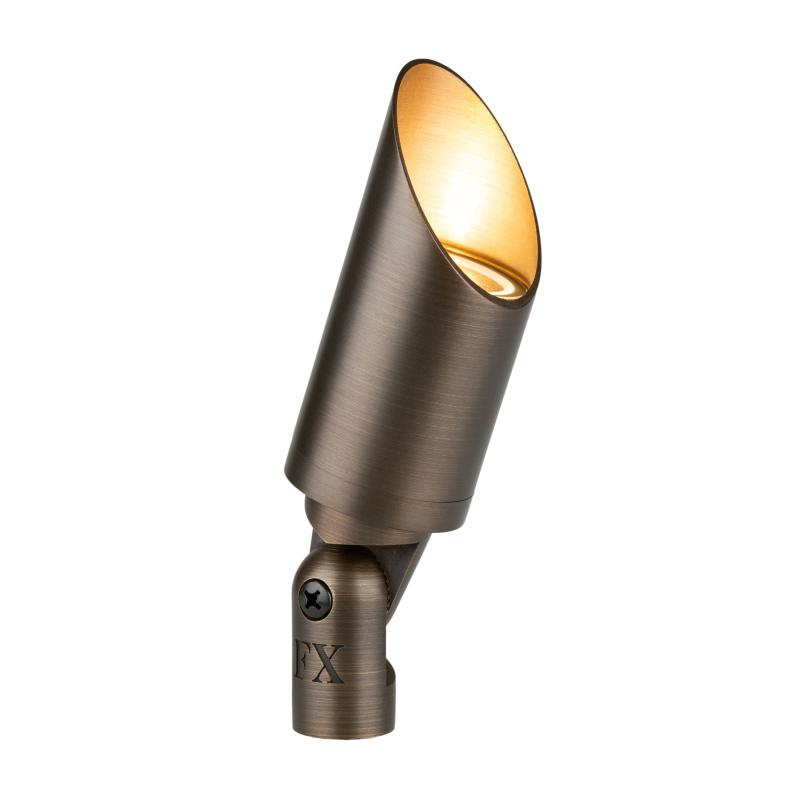
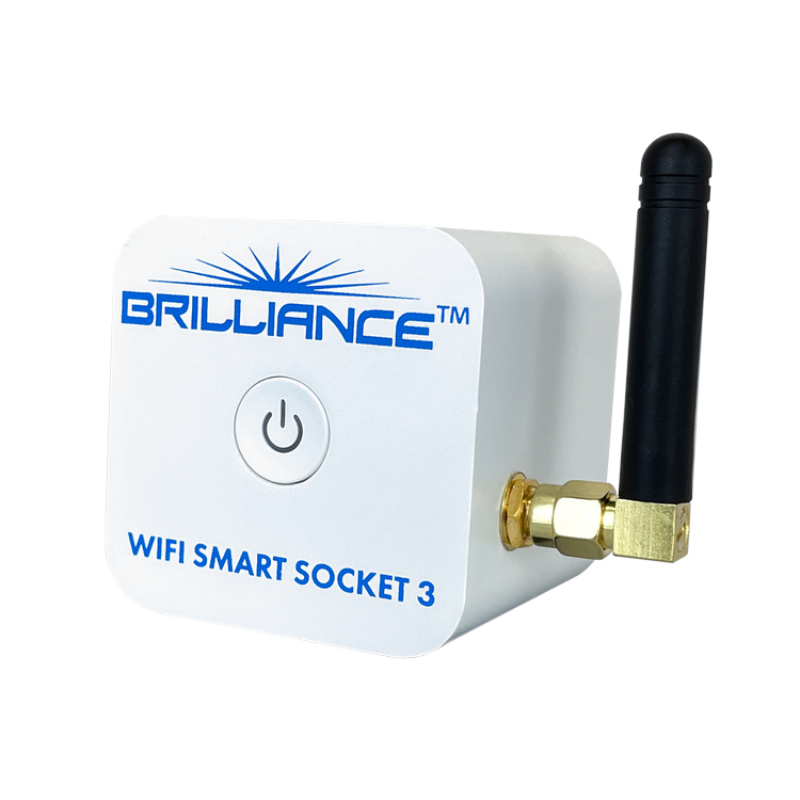
For larger installations, we recommend 150W, 300W, or 600W transformers from FX Luminaire, Alliance, or Brilliance LED — all available with smart WiFi control.
Step 3: Plan Your Wire Layout
There are three common wiring methods for landscape lighting:
Daisy Chain (Series)
One wire runs from the transformer to each fixture in sequence. Simple but causes voltage drop — the last fixtures on the run will be dimmer than the first. Only suitable for short runs with few fixtures.
Hub Method (Home Run)
A single heavy-gauge cable runs from the transformer to a central hub, then individual wires branch out to each fixture. Provides even voltage distribution but uses more wire.
T-Method (Split Run)
The most common professional method. A main cable runs from the transformer, and fixtures tap off at intervals using T-connectors. Balances voltage distribution with efficient wire use. This is what we recommend for most residential and commercial installations.
Step 4: Make Your Connections
Use waterproof wire connectors rated for direct burial. The two most common types:
- Pierce-point connectors — push the fixture lead wire into the connector, which pierces the insulation to make contact. Fast but less reliable long-term.
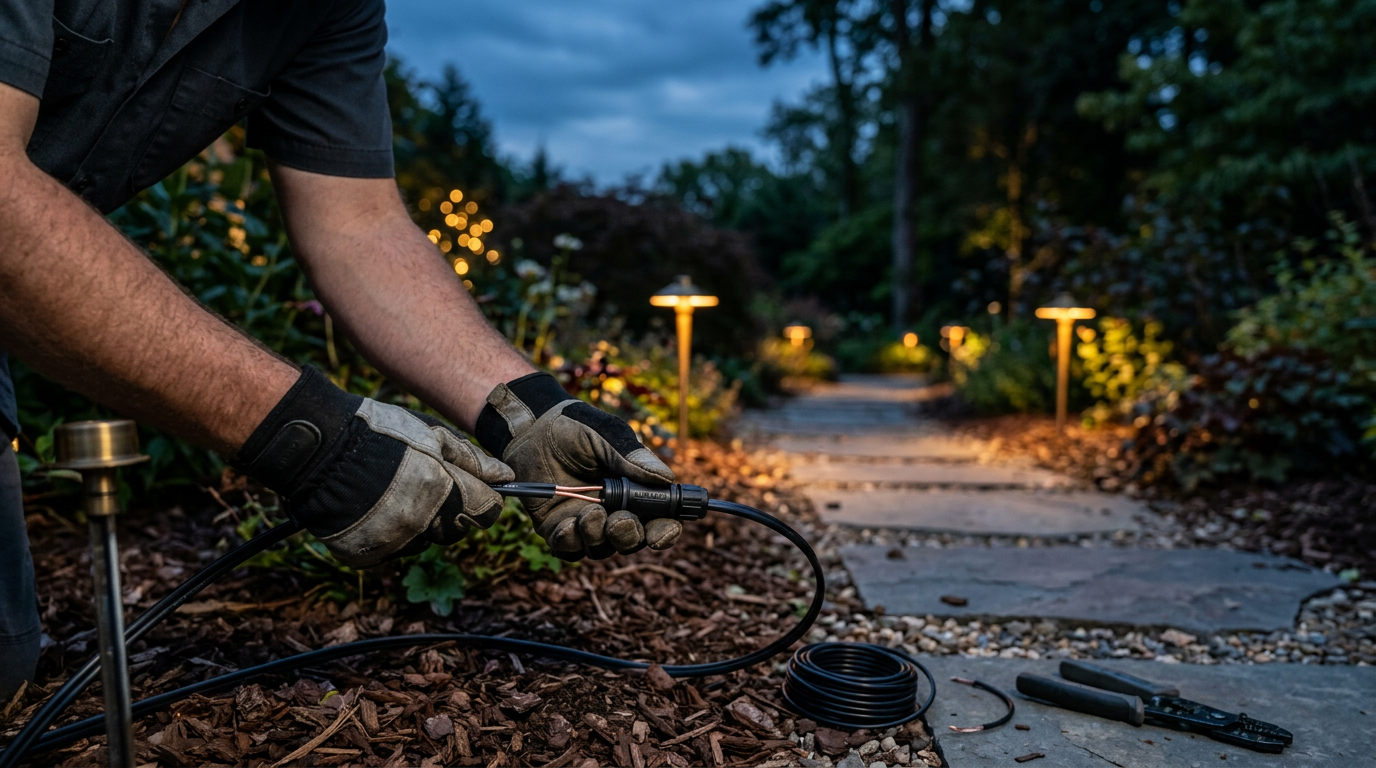
- Waterproof wire nuts (DryConn) — strip the wire ends, twist together, and cap with a waterproof connector filled with dielectric silicone. More reliable and serviceable. Browse our wire connectors.
Pro tip: Always use waterproof connectors, even if the splice is above ground. Morning dew, rain splash, and irrigation overspray will find any exposed connection.
Step 5: Bury the Wire
Low-voltage landscape lighting wire should be buried 6 to 12 inches deep. The NEC doesn’t mandate a specific depth for low-voltage landscape lighting, but 6 inches minimum protects the wire from lawn mowers, aerators, and foot traffic.
Use a flat spade or a cable-laying tool to cut a narrow trench. Lay the wire in the bottom and close the trench — the grass recovers within a few weeks.
Step 6: Test Before Final Burial
Before closing all trenches, power on the system and check every fixture:
- All fixtures illuminating at the expected brightness
- No flickering or dimming at the end of runs
- Transformer not overloaded (check amperage draw)
- Timer/photocell triggering correctly
Common Mistakes to Avoid
- Wire too thin for the run length — causes voltage drop and dim fixtures at the end of the circuit
- Overloading the transformer — running at 100% capacity reduces transformer life and causes overheating
- Non-waterproof connections — the #1 cause of landscape lighting failure. Always use rated waterproof connectors
- Mixing LED and halogen on the same run — LED fixtures draw much less current, causing voltage regulation issues on mixed circuits
- No slack at fixtures — leave 12-18 inches of extra wire at each fixture connection for future servicing
Frequently Asked Questions
Can I bury landscape lighting wire without conduit?
Yes. Low-voltage direct-burial landscape lighting wire is designed to be buried directly in soil without conduit. The insulation is rated for underground moisture exposure. Just verify the wire you’re using is marked “direct burial” or “UF” rated.
How far can I run landscape lighting wire?
With 12 AWG wire and LED fixtures, you can run 150-200 feet from the transformer before voltage drop becomes noticeable. For longer runs, use 10 AWG wire or split the circuit into multiple home runs from a multi-tap transformer.
What’s the best wire gauge for LED landscape lighting?
For most residential LED installations (under 100 feet), 12 AWG or 14 AWG is sufficient. LED fixtures draw very little wattage compared to halogen, so the wire can handle many more fixtures per run. We recommend 12 AWG as the default for all new installations — the small cost difference provides significant future-proofing.
Do I need a special transformer for LED landscape lights?
Most modern landscape transformers work with LED fixtures, but some older magnetic transformers have a minimum load requirement that very low-wattage LED systems may not meet. Electronic and smart transformers from brands like FX Luminaire, Alliance, and Brilliance LED are designed specifically for LED loads with no minimum wattage requirement.