What Is 2-Wire Decoder Irrigation?
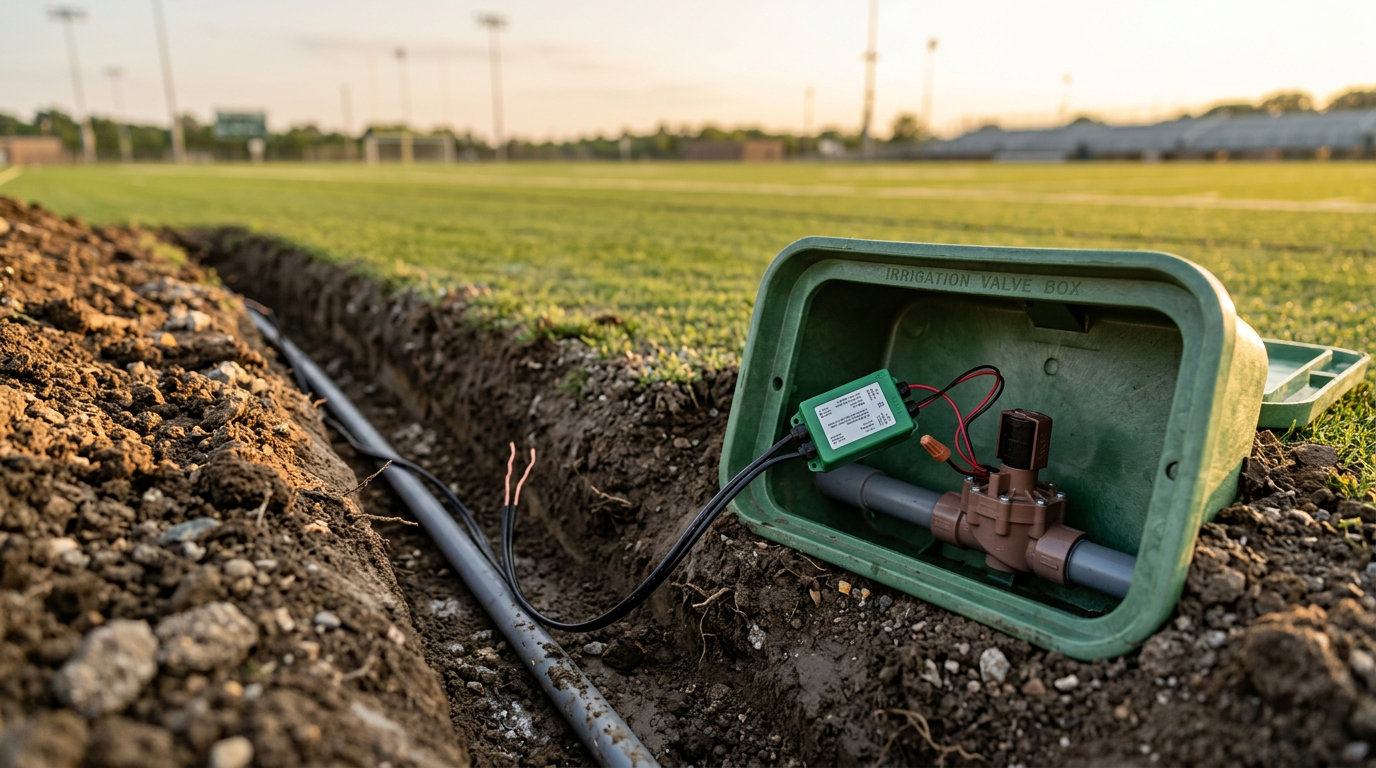
Two-wire decoder irrigation is a technology that replaces the traditional bundle of individual valve wires with just two conductors running from the controller to all field stations. Instead of pulling a separate wire for each valve zone, a single two-conductor cable carries both power and data signals to decoders installed at each valve location.
This approach drastically reduces wire costs, trench sizes, and installation labor on large-scale systems — making it the standard for commercial landscapes, sports fields, parks, golf courses, and HOA common areas with 20+ zones.
How Does a 2-Wire Decoder System Work?
In a conventional irrigation system, the controller sends a 24VAC signal down a dedicated wire to each valve solenoid. A 48-zone system needs 48 individual wires plus a common — that’s a 49-conductor cable bundle.
A 2-wire decoder system replaces all of that with a single 2-conductor path wire. Here’s how it works:
- The controller sends encoded digital signals down the two-wire path
- Field decoders installed at each valve location listen for their unique address
- When addressed, the decoder opens its local solenoid valve using power from the same two wires
- The controller confirms the decoder responded, providing fault detection
This means a 200-zone sports complex uses the same simple two-conductor cable as a 20-zone commercial property — the only difference is the number of decoders installed at valve locations.
When Should You Use 2-Wire vs. Conventional Wiring?
The crossover point where 2-wire becomes more cost-effective than conventional wiring is typically around 20-30 zones, depending on wire run distances. Here’s a practical comparison:
| Factor | Conventional | 2-Wire Decoder |
|---|---|---|
| Best for | Residential, small commercial (under 20 zones) | Large commercial, municipal, sports, golf (20+ zones) |
| Wire cost | Increases linearly with zones | Fixed — same 2-wire cable regardless of zone count |
| Trench size | Grows with wire bundle | Minimal — single cable |
| Maximum distance | Limited by wire gauge/voltage drop | Up to 5+ miles on some systems |
| Fault detection | Manual troubleshooting | Automatic decoder status reporting |
| Expandability | Requires new home runs | Add decoders anywhere on the path wire |
Best 2-Wire Decoder Controllers & Systems
Hunter ICC2 / ACC2 Decoder Systems
Hunter’s ICC2 and ACC2 controllers support 2-wire decoder operation with up to 54 stations on the ACC2 and expandable modules. The Hunter ICD decoder is one of the most reliable field decoders in the industry, with built-in surge protection and diagnostic feedback to the controller.
Rain Bird ESP-LXD
Rain Bird’s ESP-LXD series is purpose-built for 2-wire decoder installations, supporting up to 200 stations with the FD-series field decoders. The IQ4 communication module adds cloud-based management for multi-site operations.
Baseline 2-Wire Controllers
Baseline controllers combine 2-wire decoder architecture with advanced flow management, weather-based ET scheduling, and real-time flow monitoring — making them popular for water-conscious municipalities and commercial properties.
Installation Tips for 2-Wire Decoder Systems
- Use quality direct-burial wire — 14 AWG minimum for long runs. Our irrigation wire selection includes cables rated for 2-wire decoder paths.
- Install surge protection at both the controller and remote decoder locations, especially in lightning-prone areas
- Use waterproof splice connectors (DryConn or equivalent) at every decoder connection point
- Document decoder addresses during installation — create a map of decoder locations and their assigned stations
- Test continuity of the full path wire before installing decoders
Frequently Asked Questions
How many decoders can a 2-wire system support?
It depends on the controller. Hunter’s ACC2 supports up to 54 stations, Rain Bird’s ESP-LXD handles up to 200, and Baseline systems can manage hundreds to thousands of stations on a single 2-wire path.
Can I convert a conventional system to 2-wire?
Yes. If you have existing multi-conductor wire in the ground, you can repurpose two of those conductors as a 2-wire path and add field decoders at each valve. This is a common retrofit approach for aging commercial systems that need more zones.
What happens if the 2-wire cable gets damaged?
Modern 2-wire controllers have diagnostic features that detect cable faults and can identify the approximate location of the break. Some systems like Hunter’s ICD decoders include surge arrestor diagnostics that report back to the controller.
Is 2-wire decoder more expensive than conventional?
For small systems (under 15-20 zones), conventional wiring is typically cheaper. For larger systems, 2-wire saves significantly on wire costs and labor. The crossover point depends on wire run distances — longer runs favor 2-wire even at lower zone counts.