Rain Bird vs Hunter: The Two Giants of Irrigation
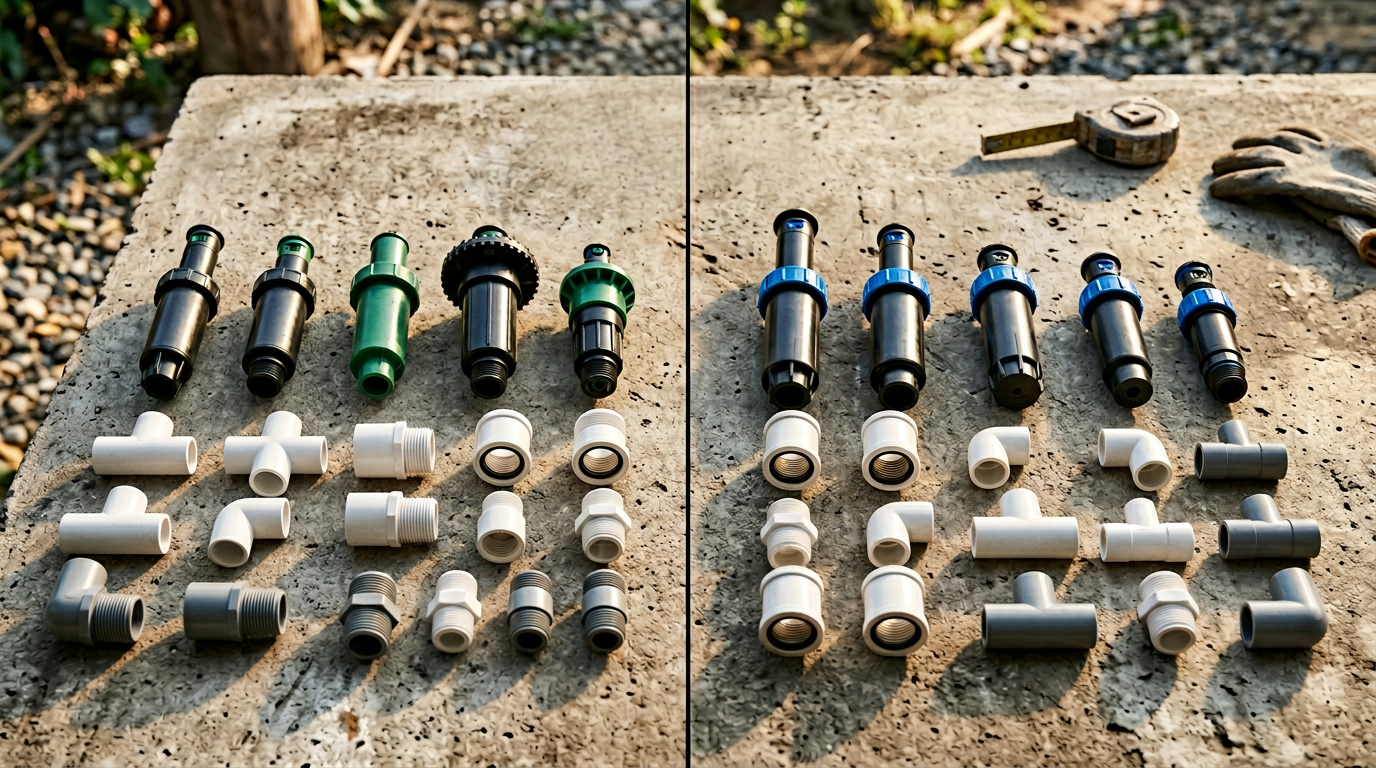
If you’re installing or upgrading a sprinkler system, you’ll inevitably face the question: Rain Bird or Hunter? Both are American-made brands with decades of professional trust, global distribution, and product lines covering everything from residential pop-up sprinklers to commercial central control systems.
This comparison breaks down both brands product-by-product across the categories that matter most: controllers, rotors, spray heads, valves, and drip irrigation.
Company Overview
| Rain Bird | Hunter Industries | |
|---|---|---|
| Founded | 1933, Glendora CA | 1981, San Marcos CA |
| Headquarters | Azusa, California | San Marcos, California |
| Market position | Oldest, largest irrigation manufacturer | Premium innovation leader |
| Smart platform | Rain Bird IQ4 / LNK2 WiFi | Hydrawise by Hunter |
| Warranty | Varies by product (1-5 years) | Varies by product (2-5 years) |
Controllers: Rain Bird vs Hunter
Residential Smart Controllers
Hunter’s Hydrawise platform (Pro-HC, HC) uses Predictive Watering with hyper-local weather data, contractor dashboards, and flow monitoring. Rain Bird’s ARC8 and ESP-Me3 with the LNK2 WiFi module offer Weather Intelligence Plus and modular expandability.
Winner: Hunter. Hydrawise’s Predictive Watering algorithm is more sophisticated than Rain Bird’s Weather Intelligence, and the contractor management tools are superior for multi-site management.
Commercial Controllers
Rain Bird’s ESP-LXD and IQ4 central control system dominates the large commercial and municipal market with 2-wire decoder support for 200+ stations. Hunter’s ACC2 and ICC2 compete strongly with excellent decoder diagnostics and Hydrawise integration.
Winner: Rain Bird. The ESP-LXD with IQ4 central control has deeper market penetration in large commercial projects, and the IQ4 platform’s multi-site management is the industry standard for municipalities.
Traditional Residential Controllers
The Hunter X-Core and Pro-C vs Rain Bird ESP-TM2 and ESP-Me3. Both are reliable, affordable, and easy to program. The Pro-C’s WiFi upgrade path (via PC-WIFI module) gives it an edge for future-proofing.
Winner: Tie. Both deliver excellent reliability. Hunter edges ahead slightly with the WiFi upgrade path on the Pro-C.
Rotors: Rain Bird vs Hunter
Residential Rotors
The Hunter PGP Ultra is the world’s best-selling rotor with over 2 billion sold. It features a non-strippable drive mechanism and through-the-top adjustment. Rain Bird’s 5000 Plus series offers a Rain Curtain nozzle technology for wind-resistant distribution.
Winner: Hunter. The PGP Ultra’s non-strippable drive and universal arc adjustment make it the most contractor-preferred residential rotor in the industry.
Commercial Rotors
Hunter’s I-20 and I-25 series compete with Rain Bird’s 5004/5006 and Falcon 6504 rotors. Both offer excellent performance, but Hunter’s Total Top Service (TTS) design — where every component is serviceable from the top without digging — is a significant maintenance advantage.
Winner: Hunter. TTS design reduces service calls and labor costs on commercial projects.
Spray Heads: Rain Bird vs Hunter
Rain Bird’s 1800 series and Hunter’s PS Ultra / Pro-Spray are both industry standards. Rain Bird offers the widest selection of matched-precipitation-rate nozzles (MPR). Hunter’s MP Rotator nozzle — which converts spray heads into high-efficiency micro-rotors — is one of the most important water-saving innovations in residential irrigation.
Winner: Hunter. The MP Rotator alone gives Hunter a significant edge in water efficiency. It applies water 3-4x slower than conventional spray nozzles, reducing runoff and improving uniformity. Check out our spray head selection.
Valves: Rain Bird vs Hunter
Rain Bird’s DV and PGA series vs Hunter’s PGV and ICV. Both use reliable globe-style designs with captured internal parts. Rain Bird’s captive screw design on the DV series prevents lost screws during service. Hunter’s PGV offers a flow control stem and manual bleed standard on all models.
Winner: Tie. Both brands produce extremely reliable residential and commercial valves. Contractor preference often comes down to local distribution and familiarity.
Drip Irrigation: Rain Bird vs Hunter
Rain Bird has a broader drip and micro-irrigation lineup, including the XF series dripline, XB emitters, and the 1800 Retro series for converting spray zones to drip. Hunter’s drip lineup is smaller but includes the Eco-Mat subsurface irrigation system and HDL dripline.
Winner: Rain Bird. A broader selection and deeper engineering history in drip and micro-irrigation give Rain Bird the edge here.
Overall Verdict: Which Brand Should You Choose?
There’s no wrong answer — both Rain Bird and Hunter make professional-quality products trusted by contractors worldwide. Here’s the simplified decision guide:
- Choose Hunter if: You want the best smart controller platform (Hydrawise), the most water-efficient spray nozzles (MP Rotator), or the most serviceable commercial rotors (TTS design).
- Choose Rain Bird if: You need large commercial central control (IQ4), the widest drip irrigation selection, or the broadest nozzle variety for complex spray layouts.
- Mix and match: Many professionals use both brands on the same project — Hunter controllers with Rain Bird valves, or Rain Bird spray bodies with Hunter MP Rotator nozzles. Components are cross-compatible.
We carry the full product lines from both Hunter and Rain Bird with authorized dealer pricing and fast US shipping.
Frequently Asked Questions
Are Rain Bird and Hunter parts interchangeable?
For the most part, yes. Standard spray bodies, rotors, and valves use the same pipe thread connections (1/2″ or 3/4″ FPT). Hunter MP Rotator nozzles fit Rain Bird 1800 spray bodies. Controllers use the same 24VAC valve wiring standard. The main exception is proprietary decoder systems — Rain Bird decoders only work with Rain Bird 2-wire controllers and vice versa.
Which brand do professional landscapers prefer?
It varies by region and contractor training. In general, Hunter has a slight edge in residential contractor preference (due to the PGP rotor and Hydrawise), while Rain Bird dominates large commercial and municipal projects (due to IQ4 central control and the ESP-LXD). Many contractors use both brands depending on the project.
Is Hunter more expensive than Rain Bird?
Pricing is comparable across most product categories. Smart controllers are similarly priced. Rotors and spray heads are within a few dollars of each other. The main price difference comes from nozzle selection — Hunter MP Rotator nozzles cost more per unit than standard Rain Bird MPR nozzles, but they use less water, which often makes them more cost-effective over time.
Which brand has better customer support?
Both brands offer excellent technical support. Hunter’s contractor support through the Hydrawise platform includes remote diagnostics and multi-site management. Rain Bird’s IQ4 platform offers similar capabilities for large commercial accounts. For residential customers, both brands have responsive phone and email support plus extensive online resources.